
Cash Flow Management – Managing Fixed vs. Variable Expenses
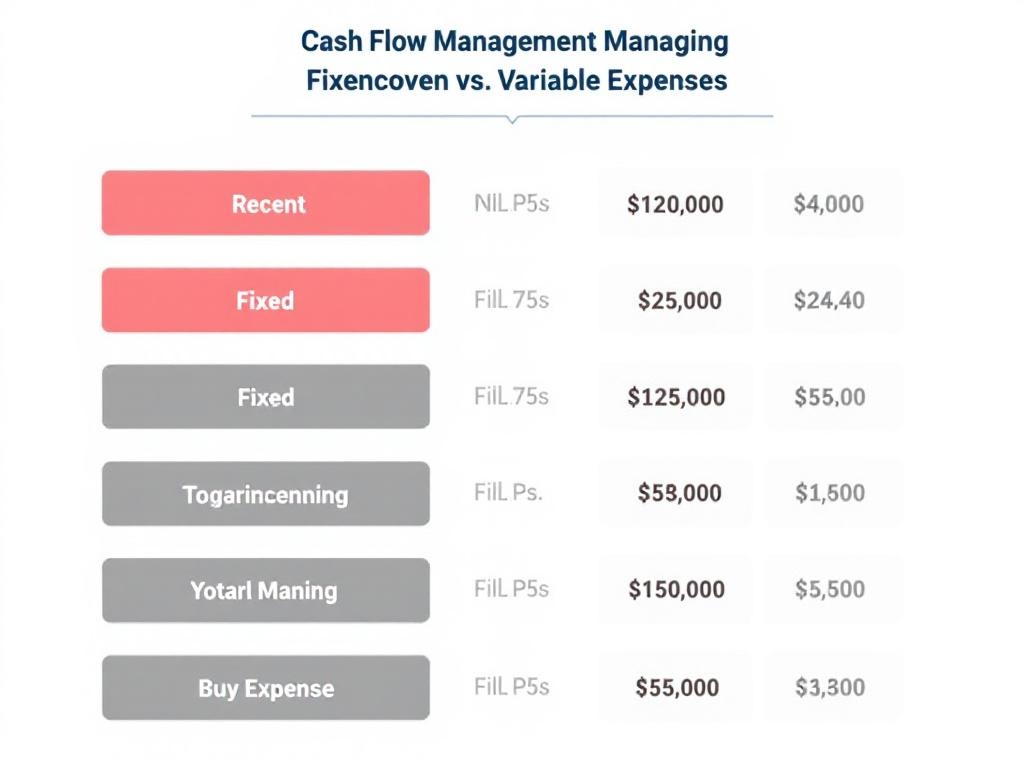
Managing fixed and variable expenses represents one of the most critical factors determining whether a business thrives or struggles with cash flow. Understanding how these expense types function differently — and learning to forecast, budget, and control them effectively — can mean the difference between sustainable growth and the 82% of small businesses that fail due to cash flow problems, according to SCORE.
Key Takeaways
- Fixed expenses remain constant regardless of production or sales, creating predictable but inflexible cash flow obligations that must be covered even during revenue downturns.
- Variable expenses fluctuate with business activity, offering flexibility to scale down costs but potentially creating cash strain when materials must be purchased upfront before customer payments arrive.
- Cutting $50,000 in fixed costs significantly lowers your breakeven point and frees up cash for growth investments or emergency reserves.
- Building a three-month buffer for fixed expenses protects cyclical and seasonal businesses from revenue fluctuations that inevitably occur throughout the year.
- Poor expense management leads to up to 5% revenue losses, making the distinction between fixed and variable costs essential for profitability and operational continuity.
Understanding Fixed, Variable, and Semi-Fixed Expenses
I’ll start with the foundation: fixed expenses are costs that remain constant regardless of business activity, production volume, or sales levels. These expenses provide a predictable baseline for budgeting, which simplifies financial planning but also creates obligations that don’t disappear when revenue drops.
Common examples of fixed expenses include:
- Rent or lease payments
- Employee salaries
- Insurance premiums
- Depreciation
- Interest expenses
- Property taxes
- Loan payments
Fixed costs stay the same whether you’re producing 10 or 1,000 units. This characteristic makes them easier to plan for but harder to adjust when business conditions change. For startups, fixed costs typically include rent and salaries as the most substantial ongoing commitments.
Variable expenses fluctuate in proportion to production, sales, or usage. These costs scale directly with business activity, which means they rise during busy periods and fall during slow seasons. This flexibility offers significant advantages for cash flow strategies, though they require more careful forecasting.
Variable expense examples include:
- Raw materials
- Shipping costs
- Sales commissions
- Hourly wages
- Utilities (electricity and water usage portions)
- Credit card processing fees
- Digital advertising (pay-per-click)
- Inventory purchases
Consider a retail business with monthly fixed costs of $200,000 plus variable costs of $40 per unit. If they produce 8,000 units, total expenses equal $520,000 ($200,000 fixed + $320,000 variable). This calculation demonstrates how variable costs scale linearly with production volume.
A pizza shop provides another practical illustration. Weekly variable costs might average $625 ($2,500 monthly divided by 4 weeks), rising to $675 during busier weeks. Variable ingredients — flour, cheese, toppings — scale directly with the number of pizzas sold, while rent and manager salaries remain constant.
Semi-fixed expenses (also called mixed expenses) combine elements of both categories. These costs include a baseline fixed component plus variable charges based on usage. Utilities often fall into this category, with a base service charge plus usage fees. SaaS subscriptions with tiered pricing also represent semi-fixed expenses — you pay a minimum amount, but costs increase as you add users or features.
| Aspect | Fixed Expenses | Variable Expenses |
|---|---|---|
| Definition | Remain constant regardless of activity | Fluctuate with production or sales |
| Predictability | 100% predictable month-to-month | Require forecasting based on activity |
| Examples | Rent, salaries, insurance, loan payments | Raw materials, commissions, shipping, hourly wages |
| Budgeting Impact | Easy to plan but inflexible | Scale with revenue but need accurate forecasting |
Allocation methods differ between these expense types. Variable costs are recorded as incurred to match revenue generation, following the accounting principle of matching expenses to the periods when related revenue is earned. Fixed costs are spread evenly across accounting periods — for example, annual rent is divided into monthly expenses regardless of actual payment timing.
Fixed expenses offer stability and predictability but must be paid even if revenue drops to zero. Variable costs scale down with lower activity, providing flexibility during slow periods, but they’re often paid upfront. Raw materials, for instance, must typically be purchased before you receive customer payment, creating temporary cash flow pressure.
How Fixed and Variable Expenses Impact Your Cash Flow
Fixed expenses create a stable but inflexible baseline that must be covered regardless of revenue performance. During low seasons or economic downturns, these costs strain cash flow because they don’t decrease when sales decline. I’ve seen businesses with high fixed costs struggle significantly during unexpected revenue drops, precisely because they couldn’t reduce their expense baseline quickly enough.
Variable expenses offer flexibility by scaling with demand, which protects your cash position during slow periods. However, they can cause short-term strain if paid upfront. Large purchase orders for raw materials, for example, require immediate cash outlays before you’ve manufactured products, sold them, and collected payment from customers.
Balancing both expense types is critical for profitability, operational continuity, and funding growth initiatives. According to SCORE, 82% of small businesses fail due to cash flow problems, often stemming from poor expense management that leads to up to 5% revenue losses.
Fixed costs are easier to budget because they’re 100% predictable, but they become risky during downturns when revenue can’t cover the baseline. Variable costs drop proportionally with revenue, which provides automatic adjustment, but they require forecasting to anticipate cash needs accurately.
Consider this example: Annual fixed costs of $120,000 equal a $10,000 monthly baseline that must be covered before achieving profitability. I recommend building a three-month buffer to handle this baseline, especially for cyclical businesses. Every $50,000 cut in fixed costs lowers your breakeven point significantly and frees cash for other priorities.
The total cost formula demonstrates this relationship clearly:
Total Cost = Fixed Costs + (Variable Cost per Unit × Number of Units)
Using the retail example mentioned earlier, this becomes $520,000 total = $200,000 fixed + ($40 × 8,000 units). This formula helps you understand how costs scale and identify opportunities for improvement.
Variable costs present a double-edged sword. They’re beneficial if revenue drops because expenses decrease automatically, protecting your cash position. They’re problematic when upfront payment is required — producing goods before receiving customer payment creates a cash gap that must be financed through reserves or credit.
Seasonal businesses face particular challenges with fixed costs. These expenses persist during low seasons when revenue falls dramatically. Restaurants in tourist areas, for instance, still pay full rent during slow winter months. Adjusting staffing to rely more on variable labor (hourly employees) rather than fixed labor (salaried managers) helps manage this seasonal mismatch.
The profitability mechanics work differently for each expense type. Variable costs directly impact gross margin — lower variable costs per unit mean higher margins on each sale. Fixed costs spread over more units at higher production volumes, reducing the per-unit fixed cost and boosting overall profitability.
You must cover all fixed costs before achieving profitability. Trimming fixed expenses lowers your breakeven point, which means you need fewer sales to become profitable. The breakeven equation illustrates this relationship:
Breakeven Units = Fixed Costs ÷ (Price per Unit − Variable Cost per Unit)
Higher production volumes dilute fixed costs per unit. If annual rent is $120,000 and you produce 10,000 units, the fixed cost per unit is $12. Increase production to 20,000 units, and fixed cost per unit drops to $6, doubling your unit profitability without changing the actual fixed expense.
Variable costs remain constant per unit but increase in total as volume rises. This means your total variable expenses grow proportionally with production, but the efficiency (cost per unit) stays the same. Fixed per-unit cost falls as production scales, which is why higher volumes dramatically boost profitability for businesses with significant fixed costs.
Forecasting and Budgeting for Different Expense Types
Fixed expenses simplify budgeting due to their predictability, but they demand careful planning to ensure ongoing coverage. I calculate my fixed expense baseline by summing all regular bills that don’t change month-to-month. This total represents the minimum cash requirement regardless of business activity.
Variable expenses require accurate forecasting using historical data, seasonality patterns, and growth trends to avoid overspending or accumulating excess inventory. I’ve found that reviewing at least 12 months of historical data reveals seasonal patterns that wouldn’t be obvious from shorter periods.
Inflation impacts variable costs more significantly than fixed costs. Raw material prices, shipping rates, and hourly wages respond quickly to inflationary pressures. Fixed costs like rent may be locked in by contracts for years, providing protection against short-term price increases. Identify your primary cost drivers — market conditions, commodity prices, labor markets — and monitor them regularly.
Here’s my step-by-step calculation approach:
- Fixed expenses: Sum all regular bills (rent, insurance, salaries, loan payments)
- Variable expenses: Multiply cost per unit by expected quantity sold, adjusted for seasonal patterns
Analyze patterns by tracking revenue increases versus cost increases. If revenue grows 20% but variable costs increase 30%, you’ve got an efficiency problem that needs investigation. Consult suppliers about anticipated price hikes so you can incorporate these changes into your forecasts rather than being surprised.
I emphasize building a three-month buffer for fixed costs, particularly for cyclical businesses. This reserve ensures you can cover baseline expenses during inevitable slow periods without resorting to expensive emergency financing or missing payments that damage your business’s credit.


